
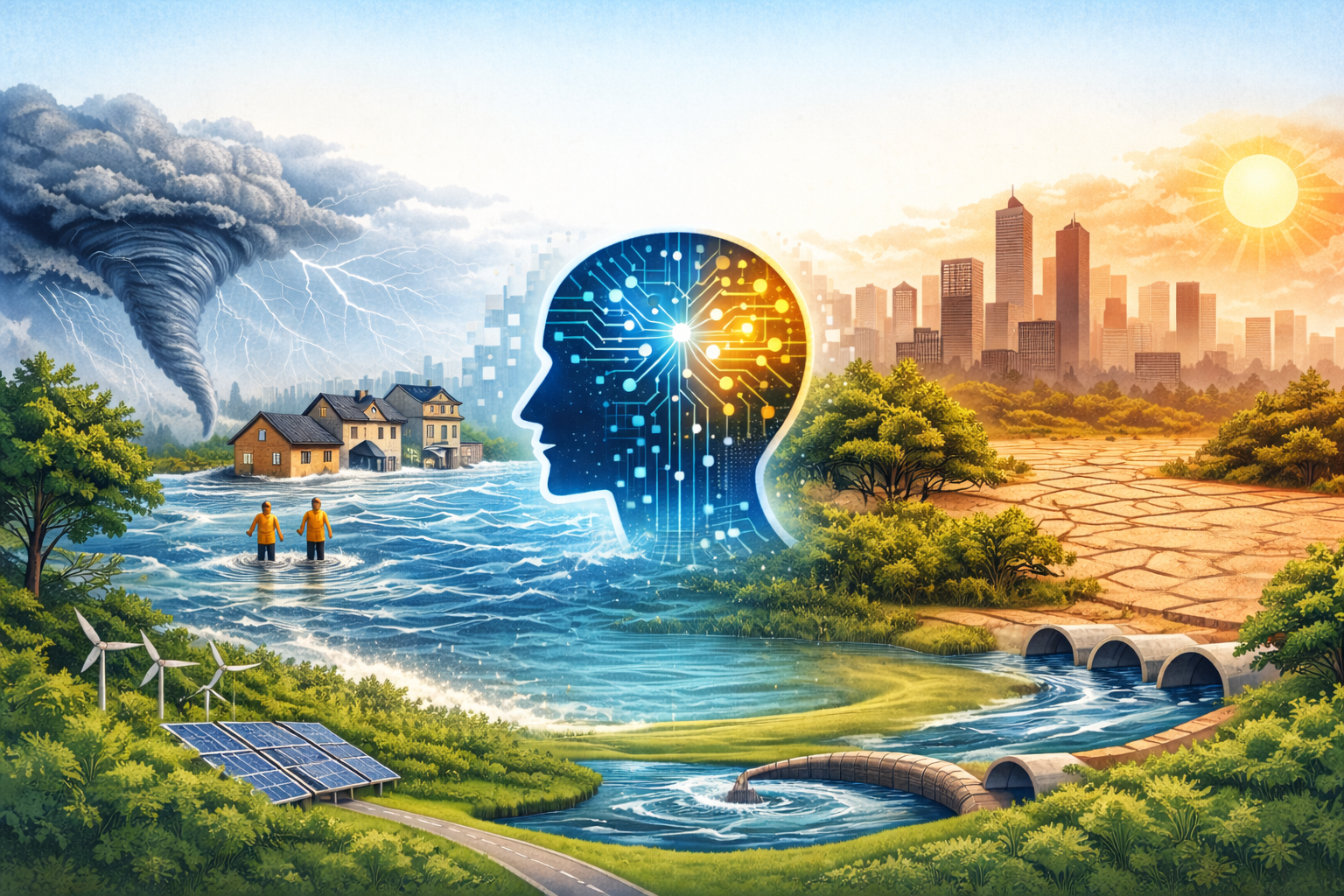
Flash floods, heatwaves, prolonged droughts… Cities are increasingly on the front line of climate extremes. What if artificial intelligence could help urban areas anticipate these shocks more effectively and adapt their water systems in time?
A recent scientific article published in Nature Communications explores exactly how AI is reshaping our understanding and prediction of extreme weather and climate events .with major implications for urban resilience and sustainable water management.
What Is the Study About?
The article “Artificial intelligence for modeling and understanding extreme weather and climate events”, led by Gustau Camps-Valls and published in February 2025 in Nature Communications, provides a comprehensive overview of how AI is currently used in climate science.
Rather than focusing on a single case study, the authors review a wide range of applications showing how machine learning can:
- detect extreme events more efficiently in massive climate datasets,
- improve short- and long-term forecasts,
- and help scientists better understand the physical processes behind these events.
In other words, AI is not only helping to predict when extreme events may occur, but also why they happen and how their impacts might unfold.
How AI Changes the Game (in Plain Language)
Traditional climate models are built on physical equations that describe atmospheric and hydrological processes. They are powerful, but they can struggle with rare, highly localized events — such as urban flash floods.
AI works differently:
- it learns patterns from large volumes of data (satellites, sensors, climate simulations),
- it can combine very different types of information (rainfall, soil moisture, land use, temperature),
- and it detects complex relationships that are hard to capture with classical models alone.
Importantly, the authors emphasize that AI is not a replacement for physics-based models. The most promising approaches are hybrid models, where physical understanding and AI complement each other.
Implications for Environment & Sustainability
For cities and water systems, the potential benefits are significant:
Better flood anticipation
AI-enhanced early warning systems could detect warning signals of sudden urban flooding earlier, giving communities more time to respond.
Improved drought and heatwave management
More accurate forecasts can support smarter water allocation, urban cooling strategies, and the protection of vulnerable populations.
Stronger climate adaptation decisions
By translating complex climate data into clearer insights, AI can help planners and decision-makers design more resilient infrastructure and protect ecosystems.
However, the study also highlights critical challenges: data gaps, algorithmic bias, lack of transparency, and unequal access to AI technologies across regions.
What to Watch Next / Open Questions
Several key questions remain:
- How can AI models become more transparent and explainable, especially for public decision-makers?
- How can these tools be integrated into operational urban services, not just research projects?
- How do we ensure that AI benefits vulnerable cities and regions, not only data-rich, high-income areas?
Bridging the gap between research and real-world implementation will be crucial.
Final Thoughts
As climate extremes intensify, artificial intelligence is emerging as a powerful but not magic tool for understanding and managing risk. Used responsibly, transparently, and alongside physical science, AI could play a key role in building climate-resilient cities and sustainable water systems.
The challenge ahead is not just predicting the future, but using knowledge wisely to shape it.
Stay curious, stay informed, and keep following how science and technology can serve a more resilient planet.

Dayana Figueroa is an environmental engineer with a Master’s in Hydrotechnological and Environmental Project Management, currently working at F-Reg in Nice. She specializes in hydraulic modeling, stormwater management, and sewage network optimization. With a multicultural background from experiences in France, Spain, Colombia, and Germany, Dayana brings diverse expertise to her field. She has a strong background in Life Cycle Assessment (LCA). Dayana is also a cofounder of the Greenminds association, combining her professional skills and LCA knowledge with initiatives to promote environmental sustainability.
Leave a Reply